
 Education
Why Most Day Traders Lose Money (And How to Avoid It)
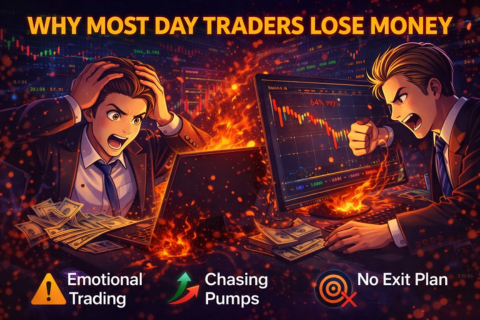
The stats are brutal: studies consistently show that somewhere between 70% and 90% of day traders lose money over time. That's not a scare tactic — it's the documented reality of one of the most competitive activities you can engage in with your capital. But here's the thing: the reasons most traders fail aren't mysterious. They're predictable, repeatable mistakes that show up across every market, every asset class, and every experience level.
Understanding why traders lose is the first step toward not becoming one of them. Let's break down the biggest culprits.
Emotional Trading
This is the number one killer. Emotional trading is what happens when your decisions are driven by fear, greed, frustration, or excitement rather than a defined process. It looks like panic-selling at the bottom of a dip because you can't stomach the red. It looks like doubling down on a losing position because you're angry and want to "get even." It looks like entering a trade because you're bored and the market is open.
The core problem is that human psychology is wired against good trading. We feel losses roughly twice as intensely as equivalent gains — a phenomenon behavioral economists call loss aversion. This means a $500 loss feels as bad as a $1,000 gain feels good. The result? Traders hold losers too long (hoping to avoid the pain of realizing a loss) and sell winners too early (locking in the pleasure of a gain before it can slip away).
Professional traders manage this by having rules that remove emotion from the equation. They define entries, exits, and position sizes before a trade is placed — not during. The plan is the plan, regardless of how the trade "feels" in the moment.
Chasing Pumps
You see a stock up 40% on your screener. It's all over Twitter. Everyone's posting their gains. You buy in at the top because it feels like it's going to keep running — and within 30 minutes, you're down 15%.
Chasing pumps is one of the most common and most expensive mistakes in trading. It happens because of FOMO (fear of missing out) combined with a misunderstanding of how momentum actually works. By the time a move is widely visible and generating social media buzz, the early movers have already entered. What you're seeing isn't the beginning of a move — it's often the end of one.
The key distinction is between emerging momentum and extended momentum. Emerging momentum is a stock or crypto that's breaking out on increasing volume with room to run. Extended momentum is something that's already moved 30–50% and is now attracting latecomers who become exit liquidity for early holders.
This is exactly why tools like StockJelli exist — to surface moves as they're developing, not after they've already played out. The screener catches stocks and crypto hitting momentum thresholds with volume confirmation, giving you a chance to evaluate entries before the crowd arrives.
No Exit Plan
Ask a losing trader why they entered a position and they'll usually give you a reason — a news catalyst, a chart pattern, a tip from someone they follow. Ask them where they planned to exit, and you'll get a blank stare.
Not having an exit plan is like getting on a highway without knowing your destination. You'll drive until something forces you to stop, and that "something" is usually a big loss or a margin call. Every trade should have two predetermined exit points defined before you enter:
- A stop-loss: the price at which you accept the trade didn't work and you cut the loss. This should be based on a technical level (support, VWAP, a moving average) — not an arbitrary dollar amount.
- A profit target: the price at which you take gains. This can be scaled (take half at +10%, let the rest run with a trailing stop) but it needs to exist.
Without these, you're relying on real-time decision-making — which, as we covered above, is dominated by emotion. The exit plan is what separates trading from gambling.
Overtrading
More trades does not mean more profit. In fact, the opposite is usually true. Every trade carries a cost — commissions, spreads, slippage, and the psychological weight of managing another open position. Overtrading dilutes your focus, increases your exposure to random market noise, and racks up fees.
Overtrading typically comes from one of two places: the need to "always be in something," or the desire to make back losses from earlier in the day (revenge trading). Both are emotional, and both degrade your edge.
The best traders are selective. They wait for setups that match their criteria and ignore everything else. Some days, the right number of trades is zero. A momentum screener helps here by showing you what actually meets your standards — so you're not scanning charts aimlessly looking for something to trade.
Poor Risk Management
You can have a 70% win rate and still lose money if your losses are bigger than your wins. This is the risk management problem, and it catches a lot of traders who think "being right most of the time" is enough.
Sound risk management means controlling your position size relative to your account. A common rule of thumb is risking no more than 1–2% of your account on any single trade. If you have a $10,000 account and your stop-loss is $1 away from your entry, your position size should be no more than 100–200 shares — not 1,000 shares because you "feel good about this one."
The math matters more than the conviction. One blown-up trade can erase weeks of careful, profitable work. Professional traders survive drawdowns because no single trade can seriously damage their account.
No Edge, No Process
Many traders operate without a clearly defined edge. They jump between strategies — breakouts on Monday, mean reversion on Tuesday, options scalping by Wednesday — without ever mastering one approach or understanding why it works.
An "edge" in trading is a repeatable pattern where the probabilities slightly favor you over many trades. It might be buying stocks that gap up on earnings with above-average volume and holding for 2–3 days. It might be shorting crypto tokens that spike 50%+ with no catalyst and fade within 24 hours. The specific strategy matters less than the consistency with which you apply it.
Without a defined process, you're just reacting to the market. And the market is very good at punishing reactive participants.
Ignoring the Bigger Picture
Individual stock or crypto setups don't exist in a vacuum. The broader market environment matters — a lot. Trading momentum longs in a downtrending market is swimming upstream. Even the best setups fail more often when the overall market is weak, when VIX is elevated, or when major macro events are creating uncertainty.
Before looking at any individual trade, check the macro context. Are the major indices trending up or consolidating? Is there a Fed announcement, CPI report, or earnings season creating volatility? In crypto, is Bitcoin breaking out or breaking down? These conditions dramatically affect your success rate on individual trades.
StockJelli shows live index data in the header for exactly this reason — market context is essential information for evaluating whether momentum setups are worth acting on today.
Most traders don't lose because the market is rigged or because they picked the wrong stock. They lose because of emotional decisions, chasing moves that have already happened, trading without exit plans, and ignoring risk management. Fixing these process mistakes won't guarantee profits — but it eliminates the most common reasons traders blow up.
Building Better Habits
The good news is that every mistake on this list is fixable. It starts with treating trading as a skill that requires structure, not just screen time. Write a trading plan. Define your criteria for entering and exiting trades. Set daily or weekly loss limits. Review your trades at the end of each week — not to judge yourself, but to identify patterns in your decision-making.
Use tools that keep you disciplined. A momentum screener like StockJelli gives you a filtered, objective view of what's moving — so you're working from data rather than hunches, headlines, or social media hype. When you see a stock or token on the screener, you can evaluate it against your own criteria rather than reacting emotionally to a chart someone posted on Twitter.
Trading doesn't have to be a losing game. But winning requires a process — and the discipline to follow it even when your emotions are telling you otherwise.
StockJelli is an educational tool. This article is for informational purposes only and does not constitute financial advice.
See what's moving right now
Open the Screener